China's Bubble Tea Industry Slowdown Sparks a Hunt for New Categories
Key facts
China's largest bubble tea chains reported mid-2026 earnings this week showing one pattern across the category: domestic store growth is losing speed and profit is under pressure almost everywhere at home, while overseas expansion is splitting hard between markets that are working and markets that are not. Mixue Group, the industry's largest player by store count, posted first-half 2026 profit down 14.7 percent year on year to 2.32 billion yuan, or about 345 million dollars, even as revenue rose a modest 2.3 percent and gross margin slipped to 30.4 percent from 31.6 percent. Its global network reached roughly 63,950 stores across 17 countries, up about 20 percent year on year, well below Mixue's growth rates in prior years. Only 4,378 of those stores sit outside mainland China, and that overseas count has been shrinking after Mixue closed roughly 428 underperforming locations over the past year, most in Indonesia and Vietnam, while opening new stores in Kazakhstan and the United States and launching its Lucky Cup coffee brand in Malaysia and Thailand.
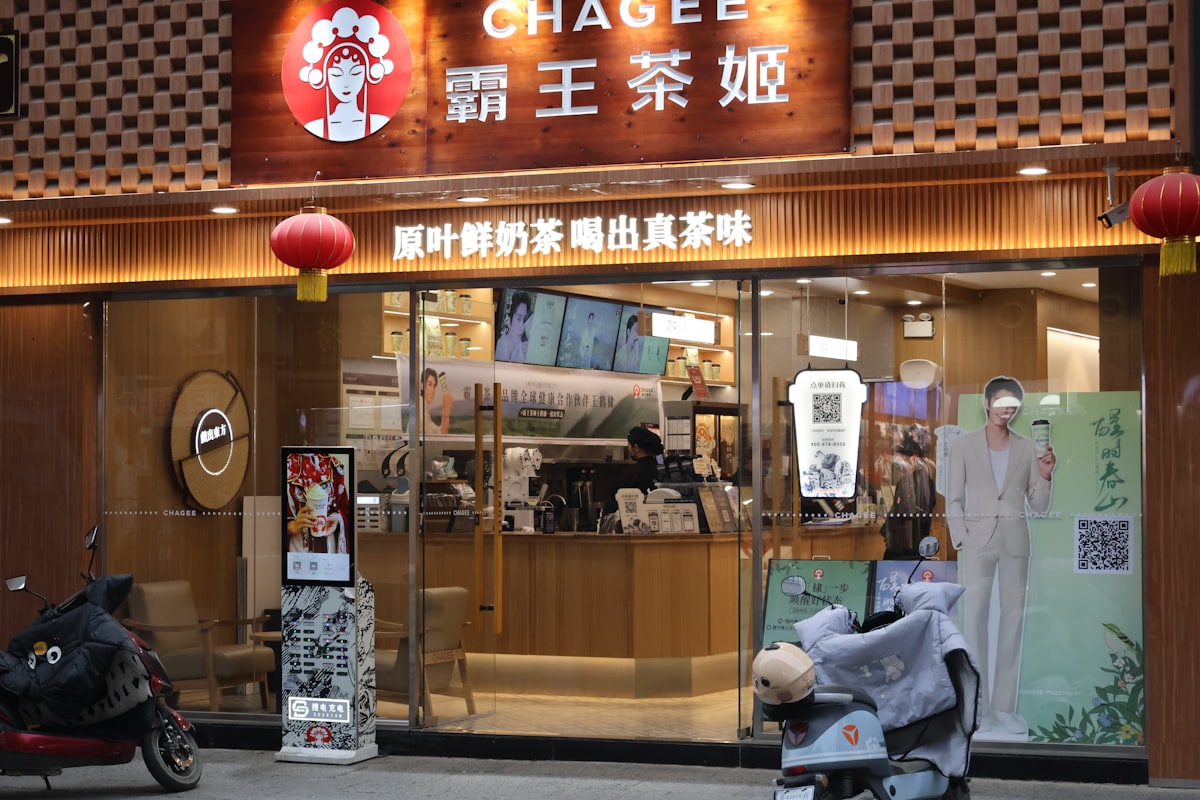
Chagee showed the same domestic brake with a starker overseas contrast. Its Greater China business added just 83 net new stores in the second quarter, a sharp slowdown from its earlier pace, and same-store sales in China slipped in July. Overseas, its 399 stores across eight markets grew far faster: the Indonesia count alone jumped from 8 to 46 locations in a year, and overseas gross merchandise value more than doubled. Guming moved the opposite direction, still growing hard at home, revenue up 31.9 percent and stores up 28.4 percent to 14,351, without yet building an overseas network at scale. Nayuki sits at the far end: its store count fell from 1,798 to 1,646 over the past year as it closed underperforming domestic shops, with no comparable overseas push to offset the contraction.
What it means for the Gulf market
None of these four chains operate in the Gulf today, but the pattern matters to anyone tracking how Chinese-style tea brands choose where to grow next. The chains pulling back hardest at home, Mixue and Chagee, are treating overseas expansion as a disciplined, market-by-market build rather than a blanket rollout: pruning weak locations in saturated Southeast Asian cities while testing further markets such as Kazakhstan, South Korea and the Americas. That is a different posture from a few years ago, when fast, low-scrutiny store openings were close to the default playbook almost anywhere a brand landed. For Gulf food and beverage operators or franchise partners weighing a Chinese tea brand's expansion pitch, mid-2026 earnings suggest the useful question is no longer how many stores a chain wants to open, but whether it has already proven it can make a new market profitable elsewhere first.
Guming and Nayuki illustrate the flip side. Guming's domestic growth is still strong enough that it has not needed an overseas leg yet, while Nayuki's shrinking store count at home shows overseas expansion is not a rescue plan available to every chain, it depends on capital, supply chain and franchise systems already built to execute it elsewhere. Any Gulf market conversation with a Chinese tea brand over the next year is likely shaped by that same test.
Background
The split shows up because China's bubble tea market has matured faster than most markets chains are expanding into. Chinese new-style tea brands had already opened more than 5,000 outlets overseas by the end of 2024, concentrated heavily in Southeast Asia, where Mixue alone ran over 2,600 outlets in Indonesia. A market still growing but filling up with competitors is why Mixue is pruning weak Indonesian and Vietnamese locations while opening new ones nearby, and why chains including Chagee are now looking past Southeast Asia toward South Korea, with Japan and the United States also drawing interest as the region gets crowded.
At home, the picture looks closer to a mature, cost-competitive market than a growth story. Store counts among the biggest chains are still rising in aggregate, but marketing, administrative and input costs are rising faster than revenue at more than one major chain, and same-store sales at some brands turned negative in mid-2026. That is the backdrop against which overseas expansion stopped being one uniform strategy and became a test each chain now passes or fails on its own terms.
Takeaway
The mid-2026 earnings season makes one thing clear: slowing domestic growth is now a shared condition across China's bubble tea category, but overseas expansion is not. It is sorting chains into those with the discipline to prune, relocate and selectively scale abroad, Mixue and Chagee among them, and those still working through domestic store economics with no overseas cushion to fall back on, Nayuki being the clearest example, while Guming shows a third path is still possible, domestic growth strong enough that going overseas has not yet become necessary. For the category, that split is a better signal of long-term health than any single quarter's store count.
Sources
- CNBC · Mixue shares extend slide after profit drop as ice cream-and-tea chain sees costs rise · August 28, 2026
- Investing.com · Chagee Q2 2026 slides: profit gains mask slowing growth · August 28, 2026
- TradingView / Quartr · Guming: Revenue up 31.9 percent and adjusted profit up 44.4 percent YoY, net profit down 3.6 percent on one-off items · August 26, 2026
- Nikkei Asia / Caixin · Chinese milk tea makers push further afield as Southeast Asia gets crowded · March 28, 2026
- VnExpress International · World's largest beverage chain Mixue shuts 428 overseas stores, many in Vietnam, Indonesia · April 21, 2026
- Longbridge · Nayuki's revenue in 2025 is 4.3 billion, a year-on-year decrease of 12 percent, with a net loss of 240 million · March 26, 2026